

Creating a golf haven
Over 50 hectares of restored landfill in Hong Kong is being transformed into an environmentally sustainable golf course.
Plover Cove Golf Club represents one of the most ambitious golf projects Hong Kong has ever seen.
A private consortium is behind the transformation of the 53-hectare Shuen Wan landfill site – located in Tai Po, in the northeast of the country, not far from Shenzhen on the Chinese border – into a remarkable golf destination.
Prior to the 1970s, Shuen Wan was a coastal inlet surrounded by small villages, fishing ponds and agricultural land. And then in 1974, as Hong Kong industrialised rapidly, the site became landfill – selected due to its relatively remote location and shallow coastal waters that were suitable for reclamation. However, by the 1990s, Hong Kong was moving towards modern engineered landfills, and older sites like Shuen Wan were gradually being phased out.
After closing in 1995, the site underwent landfill restoration. It was covered with protective capping layers and gas management systems were installed. It was eventually converted into a managed green space, but with strict usage limits.
Fry/Straka Global Golf Course Design was appointed to create an 18-hole golf course on the site. “Because of the cross-training of our staff in the disciplines of civil engineering, environmental design, landscape architecture, agronomy and turfgrass management, we get asked to work on some pretty complex permitting and engineering projects,” says Straka. “This one, by far, was the most complicated.”
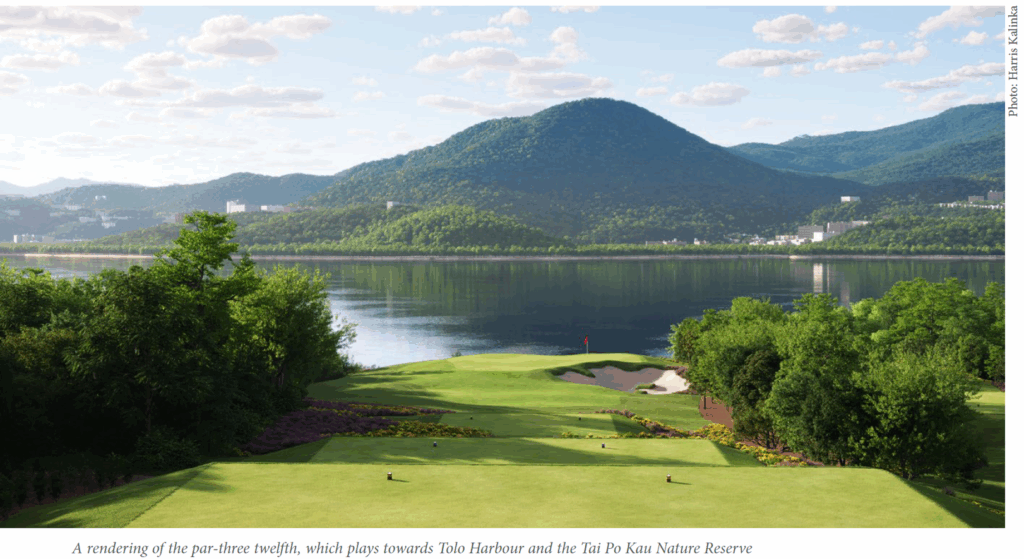
The routing was developed by Fry/Straka’s senior design associate Bill Kerman, a former civil engineer. “His ability in site grading, stormwater management, coupled with his artistic ability in creating golf holes out of literally nothing is unrivalled,” says Straka. Some holes were identified early – such as the opener and closer of each nine, whose locations were dictated by the selection of the clubhouse site on the water’s edge, and the par-three twelfth, which plays downhill towards the Tolo Harbour. The rest followed, many traversing the steep sides of the domed site.
In 2024, Fry/Straka’s masterplan was approved, and Flagstick Golf Course Construction Management began construction, with agronomy consultancy Turfgrass taking a lead role. The course is expected to be complete in 2027.
“From pre-construction project management, drainage systems and SubAir, detailed agronomy specifications to maintenance facility design, our focus has been to deliver a high-performance golf course capable of thriving in Hong Kong’s unique climatic conditions,” says John Clarkin, founder of Turfgrass. “The systems we have implemented, from sandcapped fairways to advanced moisture management technologies, will ensure year-round consistency and exceptional playing standards.”
“We are creating many golf holes out of steep side-slopes, where reinforced structures are placed on the downhill side to accommodate the volume of fill required to create a level enough playing surface,” says Straka. “Essentially, you are creating golf holes on the side of a mountain. It’s a special skill to be able to do that.”
Greens will be the Zoysia Ultradwarf cultivar Lynkz; Stadium Zoysia is being used on tees, fairways and semi-rough; and L1F-S Low Rider Zoysia has been selected for low maintenance areas and planted underneath the heavily landscaped corridors. All of the above is supplied by Sports Turf Solutions. The combination is designed to thrive through typhoon events and seasonal climate extremes.
“Essentially, you are creating golf holes on the side of a mountain. It’s a special skill to be able to do that”
“An important aspect of developing this golf course, is the opportunity to transform previously unusable land into an environmentally beneficial asset,” says Clarkin. “The site currently supports a population of black kite birds within an area of approximately 1.2 hectares. As part of the development, we aim to increase this population by dedicating more than 10 hectares to new tree planting, creating improved habitat and feeding opportunities.
“In addition, clean material will be brought onto the site and placed above an existing protective barrier that covers historic deposits. This approach allows the golf course to be shaped and contoured without disturbing anything beneath the surface. By working entirely above this barrier, the project enables the creation of a new ecosystem on land that was previously unused by both people and wildlife, supporting the return of flora and fauna while providing a top-class and sustainable recreational facility.
“Plover Cove represents a defining moment for sustainable golf development in Asia. Our work on this project goes beyond agronomy, it demonstrates how world-class playability, environmental responsibility and long-term resilience can coexist on one of the most challenging sites.”
Source: GCA